Hello supporters of Douglas-Fir National Monument,
Whew! The holiday season is past. Hope it went well for you.
If you didn’t have a chance to submit comments on the amendments to the Northwest Forest Plan, you still have until January 29 to do so. (Some documents say the comment period ends Feb 2. confusing, huh? Play it safe and submit your comments by Jan 29.)
The resulting plan will likely rule for many years, so this is your chance to help the Forest Service get it right.
The original Northwest Forest Plan was an early step in recognizing that the forest must serve as more than a source of lumber. Research was showing that mature and old growth stands were vital for the survival of the Northern Spotted Owl, salmon and other animal species. It was no longer seen as a “biological desert”devoid of value beyond board feet of timber.
The original Northwest Forest Plan had impact in these ways:
- It set aside some stands of old growth trees.
- It established Late Successional Reserves (LSRs) to allow some maturing trees to become old growth, bringing the relentless cutting of mature and old growth trees under some control.
- It brought the issue of protecting species directly into the discussion of logging on public lands
- It opened the door to considering other uses for the forest besides simply cutting trees.
In your own words (pre-written comments are all treated as one comment), you can express our aspirations for Douglas-Fir National Monument by making the following points:
- This public land is the last stronghold for mature and old growth forests.
- In order to make good on its original intent, the Northwest Forest Plan must be improved in these ways:
- The category Matrix lands is outdated. Mature and old growth trees exist beyond the Late Successional,Reserves.
- Public forests provide just a relatively small amount of timber to the mills.
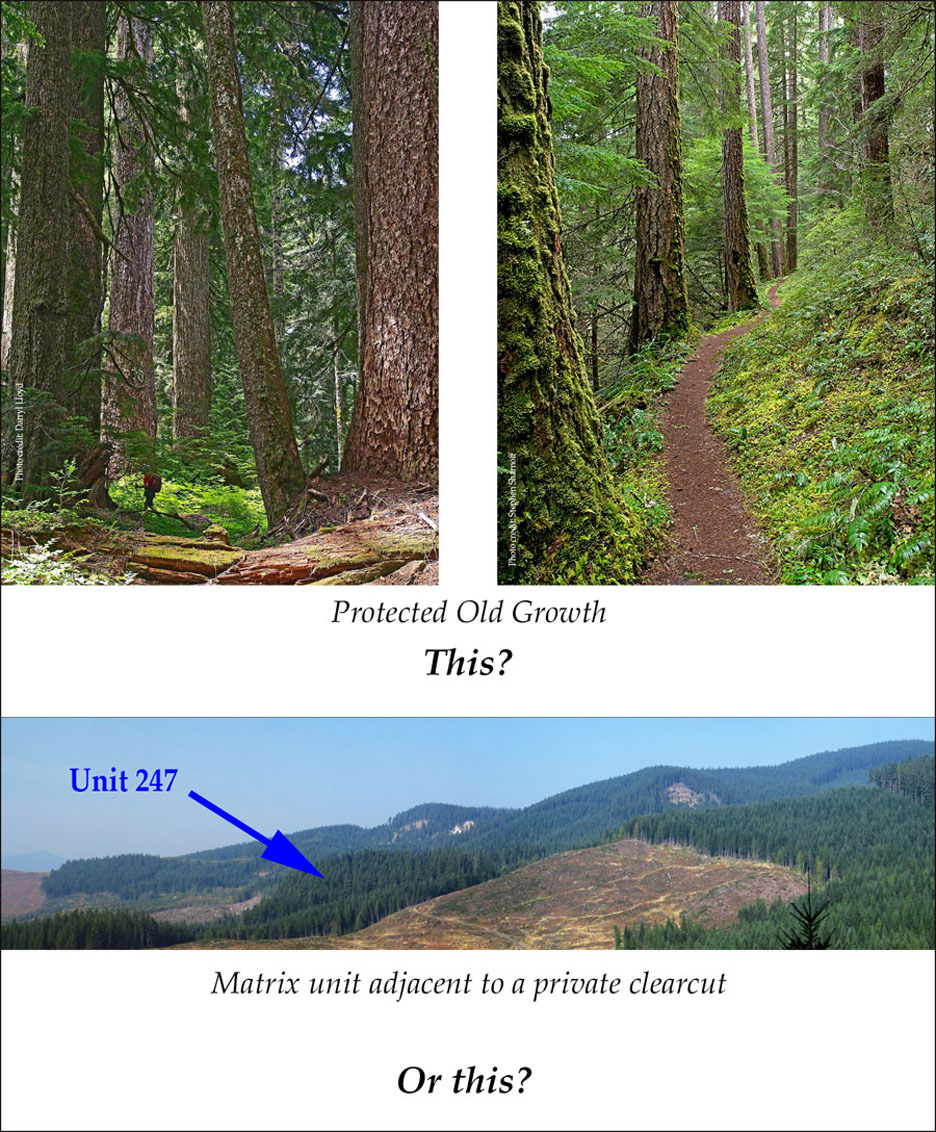
- Matrix designation occurs on many FS properties, mostly adjacent to routinely clearcut, private properties. Exempting them from LSR protections leaves those lands vulnerable to fragmentation and continuity needs of wildlife. The cumulative effects of such fragmentation increasingly harms wildlife. The little acreage left for wildlife is mostly on public lands where it is in the interest of the public to provide wildlife protection.
- Claims that wildlife such as songbirds need more early seal habitat are not credible. There is already plenty of seral habitat on clearcut private property. Public land is the only refuge left for wildlife that depends on natural forests.
- The Matrix category can and must be eliminated, and can be done without harming the local economy.
- In the decades since the Plan was first implemented, conditions in the forest have changed in many ways.
- Larger and more frequent wildfires have become the new normal, making protection of mature and old growth trees all the more urgent.
- Climate change has become significant and is getting worse. Mature and old growth trees play a major role in sequestering atmospheric carbon.
- The Tribes’ needs have long been ignored and can begin to be met by retaining and improving the natural forest.
- Covid has generated a great increase in visits to the great outdoors. No one wants to visit or hike in “managed” forests.
- The timber industry has always coveted public trees. Now is not the time to go backwards to the old days that changed our natural forests for the worse.
- The original Northwest Forest Plan was highly innovative for its time. Times change. Needs change. The Federal agencies have made the changes before. They shouldn’t be afraid to boldly go where no one has gone before.
For more information, go here:
|

 facebook