site title

HOME PROTECTION NATURE PLAN YOUR VISIT FAQ JOIN/DONATE ABOUT

Fish, Amphibians, and Reptiles in Douglas-Fir National Monument

The amphibians and reptiles featured below are only a selection, not a complete list, of what lives in the area of the proposed monument.

spring chinook graphic

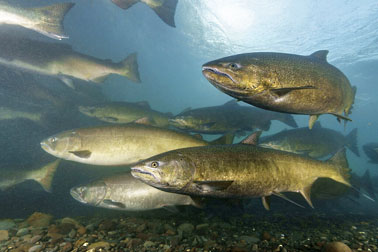
Photo: J. McMillan/Wild Salmon Center

Spring chinook salmon, Oncorhynchus tshawytscha
The largest and considered by many the finest of the Pacific salmon.  Often called "springers", they migrate from the ocean to their home rivers in spring; recent research indicates that they are genetically distinct from fall run Chinook salmon.  They have been (and continue to be) critically important to native peoples spiritually and as food.  Barriers to their migration, such as dams, and habitat loss have put the Chinook salmon in great danger, and many populations have been lost.  They are currently present in several rivers within the proposed monument, in spite of downstream dams.


steelhead

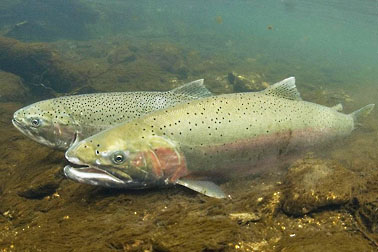
Photo: NOAA

Steelhead trout, Rainbow trout, Oncorhynchus mykiss
Steelhead and Rainbow trout are the same species, but steelhead are anadromous, that is, they migrate seasonally to the ocean. They are famous for accurately finding their home rivers after feeding in the ocean for several years. Rainbow trout are smaller, but more colorful than steelhead.  Both kinds hatch in the gravel beds of fast-flowing streams, and their habitat has been severly impacted by logging too close to streams.  Rainbows are found in several streams in the proposed monument, and summer steelhead live in the upper McKenzie main stem.


bull trout graphic

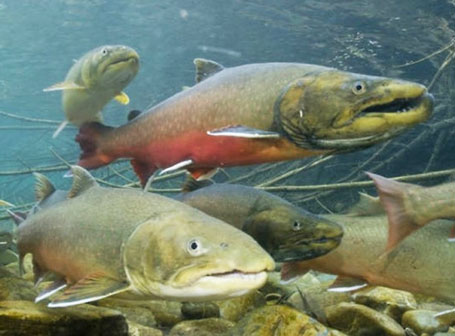
Photo: J. Satore

Bull trout, Salvelinus confluentus
Bull trout are a kind of char, and used to be called "Dolly Varden".  They either stay in their home streams throughout their lives or migrate within river systems or to the ocean. They require cold, clear water, clean gravel beds, deep pools and good cover such as woody debris or overhanging banks.  The species is a valuable game fish in Canada, but is listed as threatened in it's entire US range.  They used to live in the North and South Santiam Rivers, and if their habitat were sufficiently restored, could return there.


cutthroat trout graphic

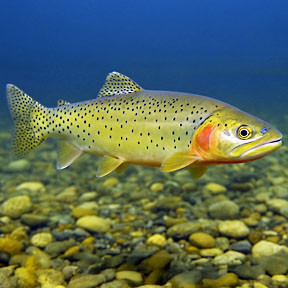
Photo: Boardwalk Lodge

Cutthroat troat, Oncorhynchus clarkii
The most common trout in Oregon, and found in almost all the streams in the proposed monument, they can grow as long as 18".  The name refers to the reddish streaks on the lower jaw, and the fish is usually spotted.  They spend part of their life in the ocean, but stay close to their home rivers, returning in late summer to fresh water streams to spawn.  A popular game fish, but threatened by habitat loss and the stocking of lakes with non-native trout.


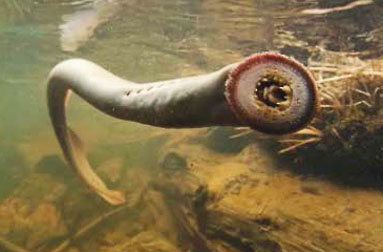
pacific lamprey graphic

Photo: David Herasimtschuk/Oregon Wild

Pacific lamprey, Entosphenus tridentatus
A "primitive" fish that resembles an eel, but lacks the jaws and paired fins of a true fish.  Their lineage is ancient, older than dinosaurs or trees.  They have a sucker-like mouth, a third eye on top of their head, and no scales or gill openings.  They migrate to the ocean, returning to fresh water streams to spawn.  Important to native peoples, they are threatened by habitat degradation; within the proposed monument, they are barely holding on in the South Santiam and Calapooia basins.  The Pacific Lamprey Conservation Initiative is a collaborative effort by Indian tribes and government agencies to restore their habitats and traditional uses.


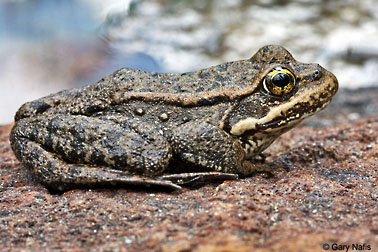
cascades frog graphic

Photo: CaliforniaHerps

Cascades frog, Rana cascadae
The Cascades frog, as its name suggests, lives near water in the Cascades; it is also found in the Olympic Mountains of Washington and the Trinity Mountains of California.  It is medium-sized, light brown to olive, with markings of bright yellow; its call is low-pitched, and described as "chuckling". Populations have declined across its range, "extremely" so in Oregon, and it is listed as a "Species of Concern".


oregon slender salamander graphic

Photo: CaliforniaHerps

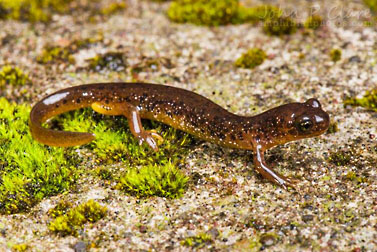
Oregon slender salamander, Batrachoseps wrightorum
A small, slender, long-tailed species, dark brown to black with a brown stripe.  It is endemic to northwestern Oregon, and found especially on the west slope of the Cascades.  It is associated with mature Douglas-fir forests, often in large decayed logs, but absent from heavily logged areas. Like most amphibians, it is threatened by habitat loss.


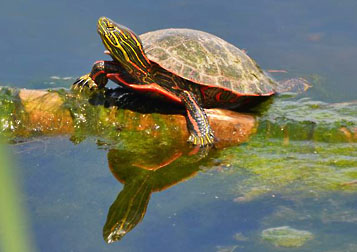
painted turtle graphic

Photo: WayneLewis/Colorado Parks & Wildlife

Painted turtle, Chrysemys picta belli

The most widespread turtle in North America, one of two native turtle species in Oregon. It grows up to about 10" in length; the top shell is brown, but the lower one has a striking red pattern.  The turtles live in slow-moving fresh water, and eat aquatic vegetation, algae, fish and small crustaceans; they, in turn, are sometimes eaten by foxes, coyotes and raccoons.

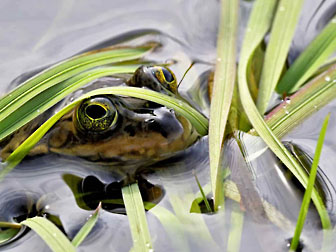
oregon spotted frog graphic

Photo: Northern Cascades Institute

Oregon spotted frog, Rana pretiosa
The scientific name means "precious frog".  It is a medium-sized frog, 3-4 inches long, brown to reddish, and endemic to the Pacific northwest.  It is the most aquatic of Pacific Northwest frogs, seldom moving far from water, and requiring water throughout its life.  It has been largely extirpated from Oregon and now is relatively rare; globally it is listed as "vulnerable".


cascade torrent salamander graphic

Photo: John Clare/flickr

Cascade torrent salamander, Rhyacotriton cascadae
This small salamander, about 2" long, is semi-aquatic, brown with a yellow underside.  They are restricted to the western slope of the Cascades, from near Mt. St. Helens to northeastern Lane Co., and need a humid forest habitat with dense canopy cover, and cold streams.  The species is threatened by habitat loss, as well as increased sedimentation due to logging and road construction.


western rattlesnake graphic

Photo: Washington Department of Fish and Wildlife

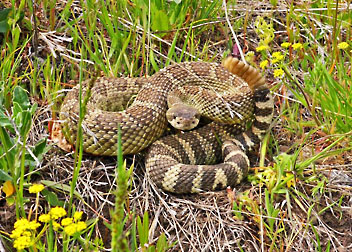
Western rattlesnake, Crotalus oreganus
A large, heavy-bodied snake, from 3' to 5', brown to gray with a pattern of blotches and pale rings, and a rattle on its tail.  It ranges over most of the western US.  The snake has a potent venom, which it uses to catch prey such as birds, amphibians and small mammals.  It is threatened by habitat loss and direct destruction. Treat it with caution!


northern alligator lizard graphic

Photo: Joe Crowley

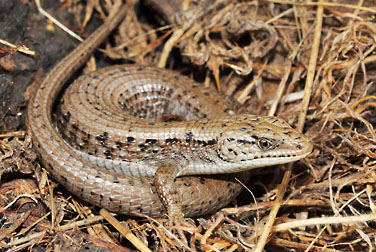
Northern alligator lizard, Elgaria coerulea
A medium-sized, gray to brown or yellowish lizard, that lives throughout much of the West, mostly in in brushy or rocky openings within forests. It eats small invertebrates such as beetles, spiders and slugs, but sometimes baby mice.  The long tail can be shed when the lizard is threatened, for example by house cats.


rough skinned newt graphic

Photo: Chayse Emge/Washington Dept. of Fish and Wildlife

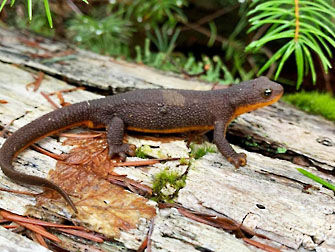
Roughskin newt, Taricha granulosa
The Roughskin newt is one of the more common newts, found in the Pacific coastal region from central California to Alaska.  It lives mostly on land, but must return to water to breed.  It is brownish with a yellow to orange underside, and a bumpy skin.  Glands in the  skin produce a potent toxin as a deterrent to being eaten, notably by its main predator. the garter snake.


northwestern garter snake graphic

Photo: Gavin Hanke

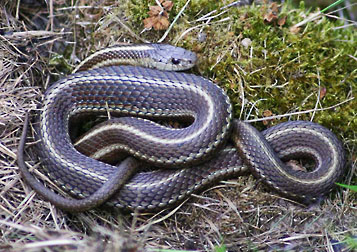
Northwestern garter snake, Thamnophis ordinoides
A small snake, 13"-38", dark brown with a stripe on its back that can be quite variable, rangeing from white to yellow, green, orange or red.  It is found across the Pacific Northwest, and usually lives on the edge of meadows surrounded by forest.  It eats snails, slugs, worms, and amphibians, possibly small fish.


common garter snake graphic

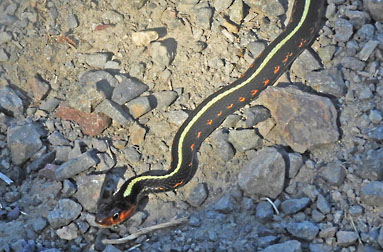
Common garter snake, Thamnophis sirtalis
This snake is widespread in North America and in the Pacific Northwest; there are a number of subspecies. They prefer moist, grassy habitats. The photo was taken in the proposed Monument.


pacific giant salamander graphic


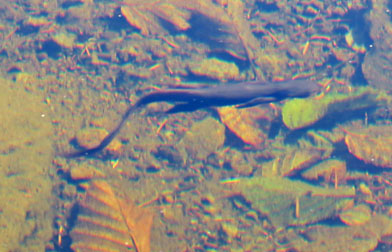
Pacific giant salamander,  Dicamptodon tenebrosus
This salamander is endemic to the Pacific Northwest. Unlike other salamanders, they sometimes make a croaking sound like a frog. The one in the photo was swimming in Crabtree Lake, in the area of the proposed Monument.


western skink graphic

Photo: esskiltonmodoc/CaliforniaHerps

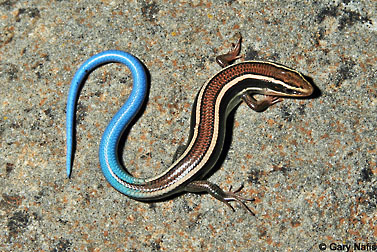
Western skink, Eumeces skiltonianus
A smooth-scaled lizard, found in most of the West, usually in fairly open habitats with scattered brush and talus that offers hiding places.  It is agile and secretive, and will bite if grasped.  It has several stripes along its body, and juveniles have a bright blue tail.  Skinks eat small invertebrates such as spiders; almost all mammals and larger birds eat skinks.


Return to Nature